What it is
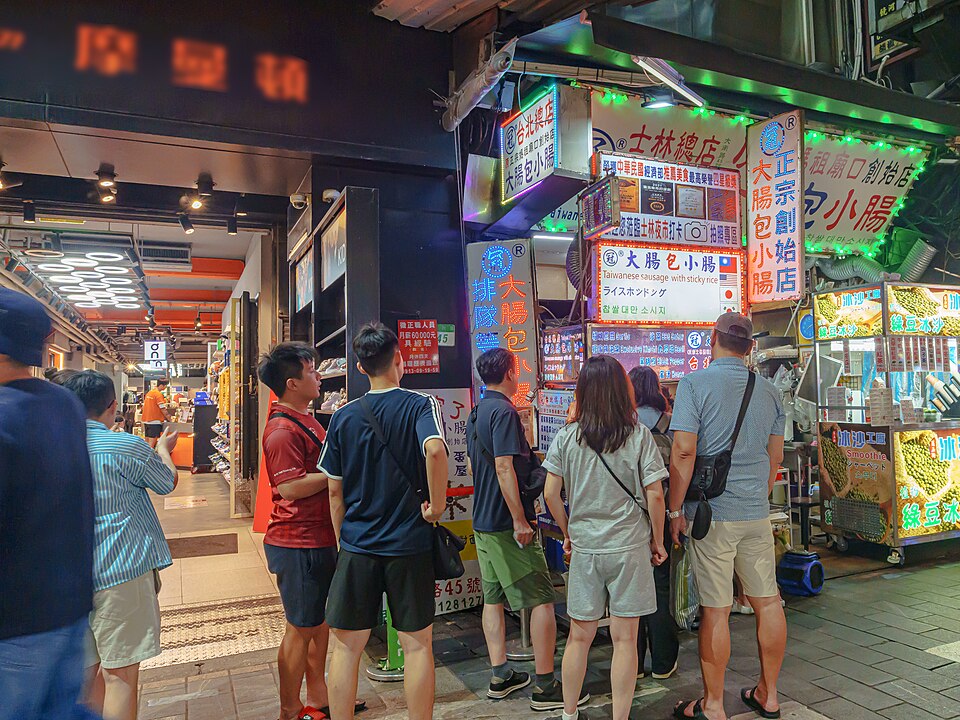
Pepper bun (胡椒餅, hújiāo bǐng) is a round bun of leavened dough filled with pepper-seasoned pork and plenty of chopped spring onion, with sesame seeds on top. It bakes stuck to the inside wall of a charcoal-fired oven. The shell comes out thin and crackly, and the filling holds hot juice. Night markets and small stalls sell it all over Taiwan.
Where it came from
Taiwanese vendors credit the bun to Fuzhou, the capital of Fujian, and many of the oldest stalls were founded by families of Fuzhou descent. Nobody knows who invented it. Its nearest relative is Fuzhou's 蔥肉餅 (spring onion and meat cake), also baked against an oven wall.
The name probably began as a pun. Early stalls sold 福州餅, "Fuzhou cake", which in Taiwanese sounds close to 胡椒餅, "pepper cake". Some older shops still keep 福州 in their names. When a classmate of the magazine publisher Pei Wei (裴偉) visited Fujian in 1993, he found neither name in use, only a 蔥肉餅 with little meat or spring onion.
The filling has changed too. It was once fat pork alone. Customers later asked for lean meat, and a family stall on Ningxia Road in Taipei moved to about three parts lean to one part fat, a style called 赤肉胡椒餅. Chinese Wikipedia dates the bun's wider popularity in Taiwan to the 1980s. Lin's (福州林記胡椒餅), opened in 1988, is described as the first pepper bun shop in Ruifang (瑞芳), New Taipei.
How it is made
The dough is usually raised with an old-dough starter (老麵) mixed fresh each day. Pork, minced or cut small, is seasoned with pepper, soy sauce, sugar and sometimes five-spice. The spring onion goes in separately so it keeps its own flavour. The sealed bun is brushed with water or sugar water and topped with sesame. Bakers slap it onto the wall of a drum oven heated by charcoal to around 300°C. They sprinkle water to stop the crust burning and lift the buns out after ten minutes or more. Many newer shops use flaky pastry instead.
How to eat it
It is a hand-held snack bought straight from the oven, and people often take several at once because queues can be long. The filling is very hot and full of juice, so the first bite needs care. Stalls usually close once the day's batch has sold out.
Around Taiwan
- North
- A stall at the entrance gate of Taipei's Raohe Night Market was listed as a MICHELIN Bib Gourmand in 2018. In Ruifang, pepper buns count among the town's "three treasures" (瑞芳三寶), with sweet potato cakes and meat rolls. Keelung's Zheng Xing (正興酥餅店), founded in 1959, sells a bite-sized pastry version.